
The number of fully-equipped multi-camera television studios in London is now very small indeed. However, over the years, London has had many spaces that were described as ‘TV studios’. Some were purpose built but others were converted from film studios, buildings with an industrial past, or simply rooms within office blocks.
This website concentrates on those studios that have made a variety of programmes for the main broadcast channels. The history of ITV and the BBC is very much tied in with those studios and how they came about. Also, sadly, how they have declined in recent years.
I have also included independent TV studios if they produced a variety of work, and film studios if they have been used to make a number of television dramas and/or other programmes on their stages. (Hence Denham isn’t included – I believe they only made feature films there.) I have also added the studios Gerry Anderson created for his TV series in the 1960s.
In order to put a limit on things I have left out the many small studios that can be found all over London – most of them being used to make news, business info, YouTube videos, shopping, bingo, porn etc. Some others available for hire are often little more than a black-painted room with a scaffold grid, a white or green cyclorama and maybe a couple of dressing rooms and a green room.
Many books have been written about the British TV and film industry – they mostly cover the programmes and films made in the studios. So this website focuses on the buildings and facilities of the various studios over the years. However, I’m aware that too many dry facts could be very boring indeed so I also include the programmes, the artists and some anecdotes associated with the studios whenever I am able to offer up a nugget of human interest.
Incidentally, I would strongly recommend what might be considered a companion volume to this website – Louis Barfe’s excellent history of British light entertainment – Turned Out Nice Again. It’s a glorious wallow in all those performers who never seemed to be off our screens from the mid ’60s into the nineties and in some cases well beyond. If you have worked in the industry you will also know many of the names behind the scenes that he mentions.
A television studio is a factory floor. It is simply the most efficient way a particular type of television programme can be made. If it could be made cheaper anywhere else it would be – and these days often is. However, don’t believe those who say that TV studios are no longer needed because of the sophistication of current cameras and ‘flyaway’ or ‘derig’ technology. Using a warehouse or very basic film stage might at first look cheaper but once you have installed a lighting grid and all the lights, dimmers and cabling, paid for several days of rigging, booked a generator, laid a TV friendly floor, discovered that the roof leaks and the walls let in the sound of local traffic and aircraft, there is no local catering and you have to put most of the crew up in a hotel – many a line producer or production manager has discovered that the fully equipped TV studio looks incredibly good value for money after all.
I normally update this page each January – this is the 2026 update. (including the BFI report on 2025, and the Film and TV Charity report on the lack of work for freelancers – both published in February 2026)
The increase in film stages continues, despite the slowdown in the rate of increase in commissioning content by the High-End TV streamers.
Since this website was launched in 2006 there have been many changes. 2020 and 2021 were of course years of huge disruption but despite the industry having to cope with Covid restrictions and many productions being postponed or cancelled, ways were found to work around the problem. By the end of 2020 most TV and film studios were coping well with the restrictions and were almost as busy as ever. The upward trend built throughout 2021 and into 2022, despite the various waves of infection.
However, just when the industry seemed to be back on its feet, there were two significant disputes that, although being US based, affected many film studios in the UK. The Writers’ Guild of America went on strike between May and September 2023, and the Screen Actors Guild – American Federation of Television and Radio Artists (SAG-AFTRA) were on strike between July and November.
The larger studios such as Pinewood, Shepperton and Leavesden were described to me as ‘ghost towns.’ This also affected thousands of freelancers who rely upon what until then had been regular well-paid employment. I gather that many have not returned to the industry, having found new jobs, whilst a majority of those remaining are still seriously questioning whether to look for another career.
In 2023 and 2024, increasing inflation and interest rates across Britain, Europe and the US also caused major rethinks in budgets and schedules by all the producers of television content. This inevitably influenced the demand for studio space. Fortunately, the slump began to recover in 2025, and 2026 looks more encouraging too.
In July 2024, a poll of 2,375 workers by BECTU indicated that nearly four out of 10 (38%) film and TV workers planned to leave the sector within five years, up marginally from its February 2024 survey (37% ) and a major jump from its September 2023 poll (24%). These are very disturbing statistics.
Confirming that things were not likely to improve soon, in March 2025 the BBC announced that spending on TV content would fall by £76m from £1.89bn the previous year to £1.82bn. According to their Annual Plan: “Despite strong growth from BBC commercial, the BBC faces an unprecedented content funding challenge, as co-production partnerships with global streamers and media companies have reduced across the sector,”
More bad news emerged in February 2026. According to a report in Screen International:
‘The Film and TV Charity has cautioned that nearly three-quarters (74%) of the UK film and TV workforce is considering leaving the industry in the past year due to financial worries.
The charity’s second Money Matters report, which asked more than 2,000 industry workers for input, revealed that many people’s financial situation has worsened since the previous report, which was published in January 2024.
Nearly half (43%) have already taken firm steps to leave, an increase from 32% in 2023, while the proportion reporting that they are finding it ‘very difficult’ to manage financially has increased from 20% to 26%.
Work scarcity is a key pressure, according to the report, with more than a fifth (22%) of respondents not in work at the time of the survey and experiencing an average gap of seven months between jobs.’
Unfortunately, there are a number of commentators who think that the boom days are over. An article in economicsobservatory.com published in January 2025 was typically pessimistic. Read it here: Why is the UK film and television sector struggling? – Economics Observator
They point out the following:
During the post-pandemic boom, streaming giants like Amazon and Netflix bought up long leases at UK studio spaces such as Pinewood. These block bookings ‘stoked demand for space’, raising costs and squeezing smaller film-makers (Croft, 2024).
But shortly after this spending spree, many firms, including Disney, Warner Bros and Comcast (another American media giant), began ‘slashing their content budgets’. This was partly because high levels of inflation in Europe, the UK and the United States were squeezing household budgets, with many people choosing to reduce spending on luxuries, including cancelling entertainment subscriptions – known as ‘cutting the cord’.
However, there have been some signs of recovery in High-End TV. In September 2024, the editor of Cinematography World wrote the following: ‘With Amazon’s recent purchase of Bray Studios in the UK, a substantial spending pledge by Disney, plus positive word amongst industry leaders we’re close to, business is slowly picking up. For anyone thinking the opposite, the message is… there is hope!’
In February 2026 the BFI issued a report covering the previous year that was relatively optimistic. According to Screen International:
‘UK film production spend hit £2.8bn in 2025, the highest figure since film records began in 2002, with overall film and high-end TV (HETV) production spend totalling £6.8bn.
The £6.8bn figure is a 22% increase on 2024 and the third highest annual spend on record. A total of 361 film and HETV productions shot in the UK, fewer than 2024’s 372, but spend was still higher, according to the BFI’s statistics.
Of the £2.8bn film spend, inward investment films contributed £2.5bn, a 35% increase on 2024; local UK films accounted for £193m, a 4% increase on 2024 and 7% of the total spend on film; and co-production spend accounted for £68m, a 14% decrease on 2024.
A total of 193 films went into production in the UK in 2025, two more than initially reported for 2024. The £2.8bn is a 31% increase on £2.1bn as first reported for 2024 (although subsequently updated to £2.3bn owing to delays in some productions reporting).’
This up-beat report sits unhappily with the other report that most freelancers are finding life very tough due to lack of work. Hard to understand how things can be going so well for the industry if so many people are planning to leave it.
Despite the relative slowdown in production, 2023, ’24 and ‘25 saw studios specialising in film and high-end television (HETV) based in and to the west of London continue to expand. From 2016, around 186 sound stages opened over the decade up to 2025. A number also opened around the rest of the UK too but nothing like this amount.
Just let that extraordinary figure sink in. If you’re wondering how it can possibly be that many, here’s how: Pinewood 14, Shepperton 17, WB Leavesden 16, Longcross North 2, Longcross South 15, Eastbrook Dagenham 12, Shinfield 18, Sky Elstree 12, Ealing 1, Elstree Studios 2, Bray 2, Bovingdon 5, Arborfield 3, Troubadour Meridian Water 6, Troubadour Brent Cross 3, Wharf Studios 6, Hoddeston 5, Garden Studios 9, West London 4, OMA:One 4, OMA:X 6, OMA:V 3, London North 5, Apple Symmetry 4, Winnersh (Parkside) 2, Wycombe 1, RD Studios 5, Farnborough 2, The Story Works 2.
Not included above are the following: 10 new stages at WB Leavesden began to be built in 2024. Gillette Building Studios were given permission in March 2025 to construct 6 new stages. Marlow Studios (18 stages), were at last given planning permission by the government in November 2025. We might expect them to open from 2028/29. Sky Elstree North was also given the green light and another 10 stages will open by 2028. Fairbanks Studios with 5 stages are under construction and will open from 2027. Langlebury is due to open 4 stages from 2027. (Pinewood plan to build possibly 5 more stages but only if a streamer books them for an extended period so this is by no means certain.)
Bray is now owned by Amazon MGM. They opened 2 more temporary stages in 2024 but announced that they would be spending millions on upgrading the facilities there. The assumption is that they will be going ahead with the scheme previously given planning permission so they will end up with 5 new stages by about 2028 (assuming that the 2 temporary stages will be replaced.)
So that’s another 56 sound stages opening between 2026 and 2028/29.
NB: In 2026 Hoddeston Studios, where Silo is based, will close. Also, Arborfield closed in February 2026 when its planning permission ended. Meanwhile, Wycombe, with 1 stage is due to become a data centre in the next two or three years.
Longcross South has been busy in recent years with its 15 stages. However, they have to leave the site by the end of 2027. The probability is that the work currently being done there will be taken up by the other studios west of London. However, it is possible that the owners might move the stages to a new site. I have not assumed this to be the case.
So, by 2028 London could have around 218 new sound stages that have opened since 2016. These of course in addition to the many that have existed for much longer at studios like Pinewood, Shepperton, Leavesden, etc.
There are unfortunately exceptions to this expansion: Sunset Studios, due to open in Waltham Cross with 22 stages, were cancelled in March 2025. HOP Studios in Bedfordshire had their planning application for 22 sound stages and supporting facilities passed in 2023 but in January 2025 it was announced that the project would not be going ahead.
Incidentally, I haven’t included here the extraordinary proposed studios at Camden Film Quarter. These are at the planning stage in Jan 2026. The scheme includes 8 large sound stages, with two towers of three on top of each other! The other two are in the basement. If it does go ahead, it is unlikely to be available till about 2029/30. Frankly, nobody can predict whether there will any demand for such facilities by then.
My guess is that no more major proposals will be forthcoming. The film and high-end TV industry will probably settle down to exist – indeed, hopefully thrive – with the facilities it has available. If more facilities are needed for a particular project then rapid-build temporary stages can be erected to cope with demand, provided by companies like Acorn Structures and Serious Stages. (Sadly, Stage 50 were taken into administration in April 2024.)
It is worth noting that although tax incentives are targeted to help the UK film industry, the revaluation of business rates that took effect in England and Wales on the 1st April 2023 became a significant new cost for studios. Another unwelcome revaluation takes place in 2026. 2023 into 2024 also saw a large increase in interest rates and construction costs due to inflation.
In his March 2024 Budget, Jeremy Hunt announced a 40% reduction on business rates for film studios, to last for 10 years. This was confirmed by the new Labour government the following October but unfortunately, it did not come into effect until 17th February 2025. Better late than never. This is a welcome change but insufficient to cover the overall increase – and construction costs still remain high.
One significant issue will possibly affect the UK industry in 2026. This is whether Trump’s threatened tariffs on film and TV made outside the US will actually happen. Nobody seems to know how this can be made to work but the uncertainty could affect where productions are made.
Update – In February 2026 Netflix announced that 7 productions that were planned to be made in the UK would now be made in the US. This is clearly not great news for British studios and the people who work in them and is almost certainly as a result of the threat of ‘tariffs’ from Trump. A spokesman for Netflix is quoted as saying “Our commitment to the UK is as strong as it’s ever been. Over the last four years, we’ve spent $1.5bn annually and that continues to be the case.” Hmm…
People sometimes claim that the London area has become the ‘new Hollywood’ but comparisons are tricky. According to the 2024 Los Angeles Film Report there were 477 certified sound stages in Greater Los Angeles. This figure also includes stages being used to make multicamera television shows. As of 2026 the main 7 Hollywood studios (Universal, Sunset, Warners, Paramount, Sony, Fox, Disney) had a total of 172 sound stages.
In January 2026 the London area had about 282 sound stages. As mentioned above, many more stages are in development.
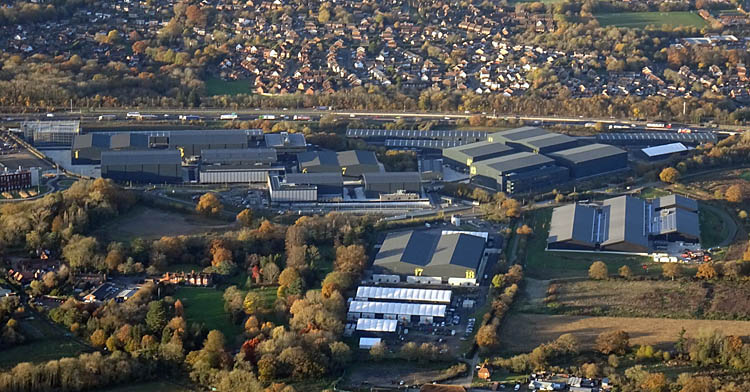
photo by Steve Sharpe
So do we really need even more stages?
According to a report published in 2022 by Knight Frank, the UK at that point had around 6 million sq ft of production space. 60% of this was in London and the South East. Total production spend was forecast to double over the following 5 years so they thought it was reasonable that this would mean an additional 6 million sq ft was required by 2026 if the sector was to keep pace with growing demand.
In October 2023 Knight Frank published an updated report. By then the UK had nearly 7 million sq ft of stage space with 71% in London and the South East.
According to the report, Netflix was the third-highest spender on content in the UK, after Sky and the BBC. All three, along with ITV and Channel 4, had been suffering from reduced revenue. It was anticipated that the days of rapid increase in content spend were over. However, the streaming platforms and film companies have continued to increase spending, albeit at a lower rate than the previous few years.
Although the report acknowledged that the rate of increase in film and HETV spending was not as high as it had been, it did predict that total production spend would reach £8.7 billion by 2028. The additional £2.4 billion in spending between 2023 and then would need around 2.6 million sq ft of additional studio space. This is what they describe as a ‘centrist’ view, so the actual figure could be somewhat higher or lower. In other words, those film studios currently proposed and being constructed are still needed.
According to the 2023 Knight Frank report:
‘Our analysis of the current development pipeline indicates that there is 3.8 million sq ft of planned stages across the top 11 developments, though just 852,000 sq ft of this space is currently under construction. In addition to these top 11 developments, other, smaller schemes are either planned or underway, which will bolster these numbers. However, based on demand projections, the amount of space currently under construction is likely to be insufficient to support the anticipated growth in the coming years.’
Despite the evidence above, some people suggest that we are planning to build too many new sound stages and some will be forced to close. While the long-term demand remains from US feature film companies and Netflix, Amazon Prime, Disney+, Apple, HBO Max and the rest of the streamers – as well as the BBC, ITV, Sky, Channel 4 etc – then the industry will continue to look healthy. Of course, this partly depends on whether the government continues to offer attractive tax breaks to production companies. Other countries are expanding their facilities too so it is vital that the UK does not slip behind. Some years ago many films were made in Eastern Europe because it became financially attractive to do so and this could easily happen again if the UK government takes its eye off the ball.
Fortunately, the current government does seem to be aware of the importance of supporting the industry. However, pressure must be maintained on them in future years to ensure that the UK remains competitive in a world market.
Unfortunately, the TV entertainment sector is not looking anything like as healthy as the HETV drama sector. Some are describing the situation as critical, with several well-known independent production companies being forced to close in 2023 and 2024. Long-running panel shows have been axed and the number of new comedy and entertainment shows made in studios has dwindled to a trickle.
The studio sitcom as a genre is now effectively dead, with only two shows – Mrs Brown’s Boys and Not Going Out – remaining. They are likely to be the last of their type made in the UK. My personal view is that the studio sitcom is a unique form of entertainment and still very popular with many viewers – as all the repeats on various digital channels indicate. However, they are unfashionable and not appreciated by the current generation of channel commissioners.
The reasons for this depressing state of affairs are complex but can be summed up thus:
The BBC have stated that apart from live shows, they will now only make programmes that will attract viewers on iPlayer. They no longer make recorded programmes primarily to be watched on BBC1 and BBC2. (BBC3 and BBC4 are effectively dead anyway.) Unfortunately, most comedy and entertainment shows that are made in TV studios do relatively poorly on iPlayer, although regular viewers of BBC1 and BBC2 still enjoy watching them. This is because the BBC are desperate to attract younger viewers rather than providing a good service to the majority of their loyal viewers who are over 50. That age group still tend to watch more linear TV than streamed TV. In other words, BBC policy is deliberately antagonising its regular viewers in order to attract the viewers who don’t watch BBC comedy and entertainment shows anyway.
Also, the BBC can no longer afford to make dramas that will not be suitable for overseas sales so these have to be co-productions.
The BBC’s finances and production budgets are now very tight indeed but will not improve until a new funding model is introduced, which is several years away when the charter is renewed. (A government White Paper on BBC funding is due in 2026).
Advertising revenue took a big hit in 2023, ’24 and ’25 due to high inflation and interest rates and increases in production costs. Consequently, ITV, Sky and C4 cut back significantly on their commissions.
The report into the state of freelancers carried out by Sky News and BECTU revealed that at the beginning of 2024 many were out of work, or jobs being offered were poorly paid and with much longer hours than previously. And it is not just scripted programmes that have been cut. The same report noted that 65% of people who usually worked in reality TV were unemployed.
The current state of multicamera TV studios:
Until relatively recently, most of Britain’s multicamera studio-based television was made in or near London, despite the desire by Ofcom to force programme makers to be less London-centric. This was because for many years, talented people from all over the UK moved to live in or near the capital. However, TV studio space in London is now very limited as a few years ago it lost most of its best designed, best equipped studios at TV Centre, TLS, Teddington and Fountain.
The BT Sport studios on the Olympic Park in East London closed in 2023. Although mostly used for their own programmes, these large, well-equipped studios were sometimes rented out to other production companies – so this is yet another useful facility we have lost.
In September 2022 London also lost stages 8 and 9 at Elstree Studios (due to asbestos and RAAC). These have been repaired and are now booked by EastEnders for 2 years from November 2025.
Meanwhile, over the road at BBC Elstree Centre, now called Fairbanks Studios, AXA insurance and Oxygen Studios took over in January 2025. Studios C, D and M have been demolished, making way for new film stages.
Then in June 2025, Pinewood closed its 2 excellent TV studios.
So, setting aside those studios permanently making soaps, news, sport or daytime magazine shows – the sad news is that London’s medium-to-large (6,000 sq ft and over) fully equipped available production TV studios as of January 2026 are at TV Centre (2), Riverside (1) and Versa (1). (TC3 at TV Centre became available again in January when ITV Daytime moved to the Hospital Club studio.)
George Lucas stages 1 and 2 at Elstree are also operated by BBC Studioworks. They do not have TV floors or lighting grids but both have fully equipped galleries and their own stock of cameras.
The Versa London studio opened in late 2021 and is a very useful 10,000 sq ft. It is well equipped but lacks a proper lighting grid which might limit its appeal. Nevertheless it is a very welcome addition to London’s TV studios.
A solution to staging very large-scale entertainment shows was found in 2018 when ITV opened a ‘temporary’ stage on Bovingdon airfield. This has no permanent technical equipment or facilities but has proved very useful for shows like Dancing On Ice, The Masked Singer and The Wheel.
So to summarise – in January 2026 in London there were only 3 fully equipped TV studios with lighting grids and TV floors over 6,000 sq ft available for TV comedy & entertainment shows. TC1, TC3 and Riverside 1. In addition, there are three large studios with technical equipment but no lighting grid – George Lucas 1 & 2 and Versa London.
Of course, to the south of London is Maidstone with two TV studios at 11,600 sq ft and 6,000 sq ft. and to the north there is the 22,000 sq ft ITV studio at Bovingdon, which has no permanent equipment at all.

In London there are a few small multicamera studios remaining, such as Cactus Clapham and IMG. TC2 is now available again, since ITV Daytime have left it. Riverside’s studios 2 and 3 are available when not being used for theatre and music performances. The One Show studio at Broadcasting House has occasionally been used for other daytime programmes, with a quick turnaround ready for the live broadcast at 7pm. The BBC Radio Theatre in Broadcasting House has televised some radio and red button concerts and hosted a few stand-up comedy series for BBC 3. It was also used for The Traitors Final Uncloaked shows in 2024, 2025 and 2026. However, despite having excellent sound facilities and a well-equipped lighting grid, the studio has no permanent television facilities – it all has to be hired in for each booking.
Sky’s studio centre in Osterley contains a number of small studios used for news and sport plus a long and narrow 5,500 sq ft ‘double’ studio that opened in 2011 in their Sky Studios building. This has in the past been used for making entertainment shows but is now permanently booked with sport programming.
The 2,700 sq ft. h Club studio (Hospital Club) closed in June 2020 due to the Coronavirus pandemic. Celebro reopened it late in 2023 but in May 2025 they closed the studio again. Since January 2026 it has been used by ITV Daytime for its morning shows.
Between 2008 and 2011, a number of other small but very useful studios closed including 124, Capital, Molinare, MTV, Technicolor (Disney) and Stephen St.
Teddington closed all its small studios in the summer of 2013 and TV Centre’s small studios were also lost in the same year.
The smaller studios at TLS were of course lost in 2018 along with the main ones. The Princess studio also closed at the end of 2018.
Outside the capital are a few medium/large (6,000 sq ft and over) multicamera studios available – in MediaCity Salford (3), Glasgow (2) and Manchester (2).
dock10 studios at MediaCity have 10 studios but only three are suitable for typical audience shows. HQ4 and HQ2 are the same size as studios 8 and 12 at Versa Manchester. HQ1 is a very large and useful studio.
The BBC’s HQ at Pacific Quay in Glasgow has an excellent 8,400 sq ft studio that is mostly used for gameshows and children’s shows. In 2022 BBC Studioworks opened a fully equipped 10,500 sq ft multicamera studio in the old Kelvin Hall building in Glasgow.
The old Granada studios 8 and 12 now have fully equipped galleries again and are run by Versa Studios.
The studio in the old BBC HQ in Cardiff (Llandaff studio C1) closed in March 2020. The new BBC HQ in Cardiff contains a 3,500sq ft TV studio but this is intended for local programming, although it is occasionally used for Crimewatch Live. The BBC’s drive-in studio in Belfast is mostly used for local programming but is now also the home of Mastermind. The BBC drama centre at Roath Lock in Cardiff makes single-camera drama although it has been used to record one series of Only Connect using an OB unit for facilities. Wales currently has one independent studio in Cardiff – the 4,800 sq ft Enfys studio – mostly making local material but is also the regular home of Only Connect.
Of course, all this poses the question – are TV studios needed any longer? Sadly, I have to conclude that they are not as important as they once were. Many entertainment shows are now made in other venues including film stages and theatres using OB trucks or derig kit. The need for a flexible lighting grid and rapid turn-arounds from one show to another are less important than they used to be. However, there are still many shows – particularly those with a studio audience – that can only be made efficiently in a fully equipped multicamera studio.
Since 2020 we have seen a rapid decline in the number of studio-based entertainment and comedy shows. This is partly driven by a change in viewing habits, with more and more people choosing to stream their entertainment rather than watching linear TV. For whatever reason, it seems that drama, reality shows and documentaries are now more popular than studio-based comedy and entertainment. Will this trend continue or have we reached a level that will sustain? Only time will tell.
Definitions:
There is understandable confusion about the difference between a studio and a stage. In the movie world a ‘studio’ can mean a company that makes feature films (Universal, Disney etc) or it can mean a site with a number of large rooms in which films are made. The site is usually referred to in the plural – thus ‘Pinewood Studios.’ However, each large room is not commonly referred to as a studio but is called a ‘stage’ and if it is soundproofed it is more accurately called a ‘sound stage’. Confusingly, in the television world a studio is what the large room itself is called.
A site containing several television studios is, I suppose, referred to as a ‘studio centre’. Thus, Television Centre now has three ‘studios’ but Shepperton Studios has thirty-one ‘sound stages’.
To be really picky, one should refer to a show being made IN a television studio and ON a sound stage.
Even more bafflingly, ITV Productions changed its name to ‘ITV Studios’ several years ago, followed in 2016 by the BBC’s in-house programme-making department, which is now called ‘BBC Studios’. ‘BBC Studios’ do not own any actual studios. (I know – that’s completely bonkers but true.) They are free to make their shows wherever they wish – which for a number of years used to include ITV’s own TV studios, which were called The London Studios. Sadly, these no longer exist so ITV now make many of their programmes in the BBC studios at Television Centre. I do hope you are keeping up with all this.
The BBC’s TV studios in London are run by a company called BBC Studioworks – and they often hire their studios out to programmes that are being made not only for ITV but also for Channel 4 or Sky. Confused? I’ve hardly started.
I have defined a television studio as one with a flat lino or resin floor upon which camera dollies can move freely without using tracks. It will also have a control gallery suite with all the necessary electronics and communications but not necessarily its own cameras. One or two studios prefer to hire these in on a day to day basis.
The studio will in most cases have a lighting grid with monopoles (sometimes called telescopes) or motorised bars (sometimes called hoists or ‘boats’) enabling fast pre-rigging and easy changes to the rig on the day.
A great deal of television drama is shot using a single digital camera and interiors are frequently shot on sound stages. Within the remit of this website, this does not make such stages ‘television studios’ – they still remain sound stages. I hope this makes some sort of sense as a sound stage is a far more basic and simple space than a television studio. A sound stage is in essence a soundproofed large room with a power supply available for lighting, and a simple but very strong overhead grid – usually steel ‘runway’ beams several feet apart – although many stages converted from industrial premises don’t even have this. The floor may be wooden or concrete but certainly not smooth enough to run a camera dolly along without tracks.
Having said the above, I have included film studios as television drama is so important to our economy as well as our culture – especially with the rise of Netflix, Amazon Prime, Disney+, Apple TV+ and other streamers in recent years.
Incidentally – I do on occasions refer to an OB ‘scanner’. This is industry jargon for an outside broadcast control vehicle, which contains production control, sound control and vision control for several cameras. However, it is a term that is hardly used any more – most people now refer to these vehicles as OB ‘trucks’.
Measuring studios:
Film stages are usually measured in feet and square feet, possibly due to the historic influence of the US film industry. A film stage is basically an empty box, in which sets are built and then lit. The position of the set within the space is not absolutely critical – unless it will only just fit or has to line up with things like a tank in the floor or variations in the grid height.
TV studios work differently. The lighting rig is put in before the set is built. The lighting director will have designed the rig, working from scale drawings given to him or her by the set designer. It is therefore essential that the set is built in the studio exactly where the LD expects it to be.
To assist the scene crew, most TV studios have footage markings along each wall. In some newer studios these are in metres or half metres but most older studios have markings in ‘metric feet.’ This curious measurement was invented by the BBC in the 1960s and is an ingenious way of enabling scenery to be built using metric measurements whilst retaining the concept of ‘feet.’ Each metric foot is 30cm long. You may recall your old school ruler having 12 inches on one side and 30cm on the other.
An old BBC ruler indicating 300mm metric feet.
TV studio sizes are still almost always measured in feet and square feet. Confusingly, the gross size of a studio is usually stated in actual square feet but length and width are usually measured in ‘metric feet.’ This is because most TV studios have a clearly marked fire lane running around the outside of the working area. This is normally about 4 feet (1.2m) wide. The working area is measured in metric feet – so might be 90 x 70 (a very useful size.) In fact, a studio marked as being 90 metric feet long is actually only about 88ft 6 inches. But let’s not worry ourselves over that.

Before the Second World War there was only one television studio centre in London – Alexandra Palace – but there were 21 film studios, each with several stages. By the early 1960s the number of film studios had dwindled to a mere handful but on about half a dozen sites around the capital television was thriving. The decline in the film industry coincided with the dawn of television so a number of studio sites were ready and available to be converted to the new entertainment medium.
The film studio capacity had exceeded the demand and many closed – either to become television studios or to be lost to redevelopment. Amongst the most famous was Denham, which in its day was the largest studio in the country with 7 stages. It closed in 1951. (Apparently, the BBC briefly considered siting its new Television Centre there, rather than at White City. I gather that the Post Office couldn’t guarantee to get the necessary sound and vision cables laid in time so it had to be rejected.)
Many film studios had been built to accommodate the system of quotas introduced by the government in 1928. This stipulated that at least 20% of all films shown in cinemas in the UK must be made in Britain. The Hollywood studio companies therefore made hundreds of ‘quota quickies’ in studios all round London – usually very cheaply but crucially giving invaluable experience to actors and crew members. After the war the quota was dropped and a tax was introduced on cinema ticket sales. These two things combined to create a rapid decline in the UK’s film industry and the inevitable result for many studios was closure. A contributing factor of course was television itself. People were not so inclined to go to ‘the pictures’ once or twice a week if they had a TV set in their own living room. This was particularly true from about 1955 when the ITV companies began broadcasting.
Those old film studios that found a new life with television included Lime Grove (Shepherds Bush), Riverside (Hammersmith), Teddington, Highbury, Wembley Park and National Studios in Elstree (which in 1938 were owned by Joe Rock).

The map shown above is taken from the International Motion Picture Almanac of 1937-38. It is thus a fascinating snapshot of the industry shortly before the war and so in industry terms, just before television changed everything.
Of the 21 studios shown, only five are still making movies – Pinewood, Shepperton, Twickenham, Ealing, ABPC (Elstree Studios) – of which two currently also have TV studios – Pinewood and Elstree Studios. Six became purely television studios – Wembley (A-R, later Fountain), Joe Rock Elstree (ATV now BBC), Shepherds Bush (BBC Lime Grove), Hammersmith (Riverside), Highbury and Teddington. Of those, four – Highbury, Lime Grove, Teddington and Fountain – have since closed. Riverside reopened in 2019 following redevelopment. Beaconsfield incidentally is now the home of the National Film and Television School.
The map is far from accurate. For example, Teddington is shown south of the river and Twickenham appears to be right in the middle of the Thames! In case you were wondering – Bray did not open until 1951 and Leavesden made its first film in 1994.
It is worth mentioning that although HDS Studios closed as TV studios, they were kept on as dry-hire 4-wallers. They were later taken over and are now marketed as West London Film Studios.
Capital closed for redevelopment in 2008 but in 2010 the studios were reopened by Marjan TV Network. The studios closed in 2014. The building was eventually demolished in 2023, having briefly been used as a cinema and entertainment venue.
Incidentally, if you are wondering who actually invented television – click on the button at the top of the page.
Finally, I have taken the liberty of copying a superb sketch drawn in 1995 by Dicky Howett. Dicky is a very knowledgeable expert on the history of British television cameras. He owns dozens of them – most of which he has returned to full working order. He and a colleague, Paul Marshall, run Golden Age Television Recreations – a company that rents out period television equipment for use as working props in films and TV programmes. Their expert knowledge has been called upon several times by me in the writing of this website.
Anyway – below is a drawing of the principal monochrome television cameras in use in London’s studios from 1937 to the beginning of colour in the late ’60s. Despite at first glance looking like a rough sketch it is in fact incredibly accurate and I have often found it invaluable in identifying camera types. It was originally printed in 405 Alive magazine and I hope the people associated with that publication and Dicky himself won’t mind me copying it here…
